His (Beethoven’s) eternal obstacles in the journey would be, first, the limitations of the human body and mind and creative potential against which he struggled relentlessly, and second, the limitations of the instrument he was writing for. He would never be satisfied with his pianos or with the piano itself, though it would evolve considerably during his lifetime — that evolution partly flowing from him.
Beethoven, by Jan Swafford, pg. 193
To listen to a 38-minute-long podcast-format conversation between two AIs about this post, tap on the audio player below.
Me:
As I learn more about the life and times of Beethoven, thanks to Jan Swafford’s autobiography of this great master, through the lens of a software developer, one awash in the latest technology, I’m beginning to realize that much of Beethoven’s inspiration came from the emergence of a new musical technology – the piano forte. In fact, after listening to Mozart in his early 20s, Beethoven suggested that Mozart’s keyboard style and compositional corpus were rooted in the harpsichord. An earlier technology that plucked the strings rather than hit them.
I’ve realized two things from this.
First, it was Beethoven’s quick embrace of the new piano forte technology that profoundly influenced his expressive range. He was, bluntly, an early adopter. Much like me, I have been using digital technology since 1976, when I started programming my first pocket calculator.
Second, my understanding of the details of the piano forte’s evolution is minimal at best, and I want to learn more.
Give me a brief history of the piano forte, and then we will discuss it and move on to creating image prompts for Midjourney that visually reflect its evolution into the modern piano. Feel free to ask me any questions about this.
Claude Sonnet 4.6 Medium:
What a wonderful parallel you’ve drawn — and it’s apt in ways that go even deeper than you might realize. Beethoven didn’t just use the fortepiano as a tool; he essentially stress-tested it to destruction, repeatedly pushing the instrument beyond its limits and demanding that builders give him more. He was filing feature requests in real time.
Here’s a short history of the fortepiano’s evolution:
The Harpsichord’s Fundamental Limitation
The harpsichord, for all its elegance, had one insurmountable problem: its strings were plucked by a quill mechanism, meaning volume and expression were largely fixed regardless of how hard or softly a player pressed a key. You could add registers (extra string sets) for variety, but you couldn’t shape a note dynamically. For the Baroque era’s aesthetic, this was fine. For the coming storm of Romanticism, it was a cage.
Bartolomeo Cristofori, c. 1700
A Florentine instrument maker working for the Medici, Cristofori invented the first hammer-action keyboard instrument around 1700, calling it the gravicembalo col piano e forte (“harpsichord with soft and loud”). His key insight was to replace the plucking quill with a tiny leather-covered hammer that struck the string and immediately escaped—bouncing back so the string could vibrate freely. This escapement mechanism is the conceptual foundation of every piano ever built.
The German & Viennese Schools, mid-1700s
Cristofori’s idea spread slowly. Gottfried Silbermann in Germany built refined versions — J.S. Bach famously criticized early ones for heavy touch and weak treble, but later praised improvements. Two distinct schools then emerged:
- The Viennese action (makers like Anton Walter, Johann Andreas Stein) — lighter, shallower, more transparent in tone. This is what Mozart played and loved.
- The English action (Broadwood in London) — heavier hammers, thicker strings, deeper touch, richer and more powerful sound.
Beethoven at the Crossroads
This is where your analogy becomes almost eerie. Beethoven started on Viennese instruments but was increasingly drawn to the English school’s greater power. In 1817, Thomas Broadwood shipped him one of his finest grand pianos as a gift — a deeply moving gesture. By then, Beethoven was losing his hearing and could feel the vibrations through the floor. He reportedly sawed the legs off another piano and played on the floor.
He was simultaneously the platform’s greatest champion and someone its hardware couldn’t yet fully satisfy. Every few years, a new fortepiano appeared with an extra octave, stronger frame, or better damping — and Beethoven immediately composed toward those new boundaries.
The Industrial Pivot, early 1800s onward
The transition to the modern piano accelerated through industrial metallurgy:
- Cast iron frames replaced wooden ones, allowing far greater string tension and thus louder, more sustained tone.
- Steel strings replaced gut.
- Cross-stringing (strings crossing diagonally) allowed longer bass strings in a smaller case.
- Double escapement (Érard, 1821) allowed rapid note repetition — trills and fast passages that were mechanically impossible before
- By Steinway in the 1850s-70s, essentially the modern concert grand was complete.
The arc is roughly 170 years from Cristofori’s first sketch to the Steinway Model D. And Beethoven sits almost exactly in the middle of that arc — which is why his music sounds like it’s bursting at the seams of its own era.
Before we move toward the Midjourney prompts, a couple of questions for you:
What visual aesthetic draws you — are you imagining these as painterly and historical, or more abstract and dramatic? And do you want the series to follow a roughly chronological arc, or would you prefer something more thematic — contrasting the delicacy of the Viennese action with the raw power of the English school, for instance?
Me:
So, during much of Beethoven’s compositional period, particularly when his hearing was still functional, he relied on the Viennese fortepiano. It was not until 1817 that he received the English action fortepiano. By then, he would have been 37.
A deeply mature composer and performer, but one who more and more could only feel his music rather than hear it.
And this also means that Mozart would have been exposed to, influenced by and played the earlier Viennese action fortepiano.
Fascinating. Mozart was not a harpsichord-only composer. He would have been influenced by emerging technology, as he was an early adopter, like Beethoven.
Claude:
You’ve just made a really important historical correction to your own earlier framing — and it’s a significant one. The narrative of “Mozart = harpsichord, Beethoven = fortepiano” is a common oversimplification, and you’ve reasoned your way past it beautifully.
Mozart was absolutely a fortepiano composer. In fact, he was enthusiastic about it. When he encountered Johann Andreas Stein’s Viennese fortepianos in Augsburg in 1777, he wrote to his father with barely contained excitement — describing the escapement mechanism, the knee levers for damping, and the evenness of touch across the keyboard. This was a man geeking out over new technology. Sound familiar?
So the more nuanced picture is this:
Mozart and Beethoven were both early adopters of the fortepiano — but of different generations of the same technology. Mozart lived and died entirely within the Viennese action world, and his compositional voice was shaped by its qualities: the relatively quick decay of notes, the transparent, somewhat silvery tone, and the light, responsive touch. You can hear this in his piano writing — the ornamental clarity, the way melodic lines float above accompaniment, the preference for elegance over brute force.
Beethoven began there too — on the same instruments, shaped by the same sonic palette. But he lived long enough to feel the technology shift beneath his hands, literally and figuratively. The English Broadwood he received in 1817 represented something qualitatively different: more sustain, more weight, more mass in the sound.
This gives you a genuinely interesting three-stage framework:
Stage 1 — The Harpsichord world. Bach, Handel, Scarlatti. Expression through ornamentation and counterpoint, not dynamic shading. The technology enforces a certain aesthetic ceiling.
Stage 2 — The Viennese Fortepiano. Mozart, early-to-mid Beethoven. Dynamic expression suddenly possible, but still delicate, intimate, chamber-scaled. The instrument rewards wit and elegance.
Stage 3 — The English action and beyond. Late Beethoven, then Schubert, Chopin, and Liszt. Power, sustain, orchestral ambition. The instrument starts to feel like a force of nature rather than a piece of furniture.
What strikes me about your software developer lens here is that this maps surprisingly well onto platform generations. Mozart was like a master developer working at the peak of one SDK (Software Development Kit) — squeezing everything possible from it, but never needing or seeing what came next. Beethoven straddled two SDKs, and the tension between them is audible in his middle and late periods. He kept writing toward a piano that didn’t yet exist.
Shall we start building Midjourney prompts based on this three-stage framework? It gives the image series a genuine narrative arc.
Me:
Yes. Let’s begin with Stage 1 – The Harpsichord world.
To answer your compositional questions about the prompt suite:
What visual aesthetic draws you? We should stick to painterly and historical. The images should pay homage to the story of the fortepiano’s development. Abstractionism and drama would detract from the story.
Yes. We should follow a chronological arc and your three steps – Baroque Harpsichord -> Vienna soft fortepiano (the Mozart/Beethoven bridge), the Classical musical era -> English action fortepiano – late Beethoven – the dawn of the Romantic musical era – Beethoven becomes a force of nature.
Claude:
Perfect. A painterly, historically grounded series with a clear narrative arc. Let’s treat each stage almost like a chapter illustration in a beautifully produced book — the kind of image that rewards close looking.
Stage 1 — The Harpsichord World Bach, Handel, Scarlatti — Baroque, roughly 1600–1750
Let’s think carefully about what this image should feel like before we write the prompt. The Harpsichord world is:
- Architecturally grand but humanly intimate — think candlelit palace rooms, not concert halls.
- Ornate and gilded — the instruments themselves were often painted, lacquered, and decorated with pastoral scenes on the inside lid.
- Socially specific — this music lived in aristocratic salons, royal courts, and private chambers.
- Visually warm but formally composed — Baroque painting (Vermeer, de Hooch, even Rembrandt) gives us the aesthetic language: pools of candlelight, rich fabrics, geometric shadow.
The harpsichord itself is the star — its wing shape, the painted case, the double keyboard on finer instruments, the quill plectra just barely visible, the lid propped open revealing the strings within.
Here is the first prompt:
Midjourney Prompt — Stage 1:
A grand harpsichord at the center of a candlelit Baroque palace chamber, painted in the style of a Dutch Golden Age master. The instrument is ornate — its case decorated with delicate pastoral scenes in gold and black lacquer, the lid propped open to reveal rows of strings within. Two keyboards visible, ivory and ebony keys catching the warm candlelight. Heavy velvet drapes frame a tall window, moonlight filtering through. Sheet music open on the stand, quill pen resting nearby. The room breathes wealth and formal beauty — gilded wall panels, a painted ceiling dimly visible above. No human figures. The harpsichord stands alone as if waiting for its master. Painterly, historically accurate, warm chiaroscuro lighting, museum quality illustration, 17th century Northern European aesthetic.
A few decisions I made that we should discuss before moving to Stage 2:
I deliberately excluded human figures. My instinct is that the instrument itself should be the protagonist in each image — its design, its presence, its personality. Figures would pull focus toward portraiture. Do you agree with that choice?
And one question: do you want each stage to feel like it inhabits a different room or setting that reflects the social world of that music — the royal palace for Baroque, perhaps a more modest Viennese salon for Mozart, a rougher, more dramatic space for late Beethoven? Or would you prefer a consistent setting that changes only as the instrument changes?
Me:
I fully agree with excluding human figures. The story is more about the three technological versions (harpsichord, Viennese fortepiano, and London fortepiano) than about a particular master (Bach, Mozart, or Beethoven).
Each of the three images should celebrate the instrument, not the musical wizard who used it to manifest their magic.
Yes. The overall atmosphere where the instrument is revealed should reflect the times of the particular instrument. The royal palace for Baroque, a modest Viennese salon for Mozart, and finally a rougher, more dramatic space for late Beethoven.
While you chew on that, I will render your first prompt. BRB.
Claude:
Perfect. While you’re rendering Stage 1, I’ll develop Stages 2 and 3 so they’re ready when you return.
Let me carefully think through the visual logic of each remaining setting.
Stage 2 — The Viennese Fortepiano Mozart / early Beethoven — Classical era, roughly 1750–1800
The Viennese fortepiano is a more domestic instrument than the grand harpsichord. It entered the middle-class home, not just the palace. The aesthetic shift is significant:
- Lighter, more elegant furniture — early Biedermeier sensibility creeping in
- Smaller, more intimate rooms — lower ceilings, simpler wall treatments
- Natural daylight rather than candlelight — perhaps a morning room, windows open
- The instrument itself is visually quieter than the harpsichord — less ornamentation, cleaner lines, a single keyboard, the hammers hidden within.
- A sense of bourgeois aspiration rather than aristocratic display
Stage 3 — The English Broadwood / Late Beethoven Dawn of Romanticism, roughly 1800–1827
This is where the visual language needs to shift most dramatically. Late Beethoven is storm and struggle. The setting should reflect:
- Something rawer — a composer’s working studio, not a salon
- Romantic era visual cues — think Caspar David Friedrich rather than Vermeer. Dramatic light, perhaps a single window with a stormy sky beyond
- The piano itself is larger, darker, more massive — the instrument has grown muscles.
- Signs of intense use — scattered manuscript pages, a broken string perhaps, the chaos of creation
- The emotional temperature is higher. Something is being wrestled with in this room.
I’ll have both prompts fully drafted and ready the moment you return with your Stage 1 render. Take your time — curious to see how Midjourney interprets the Dutch Golden Age harpsichord.
Me:


The prompt proved overly challenging for MJ 8.1.
The interior worked (a very Baroque palace), but MJ lost sight of the harpsichord and hallucinated a strange fusion of a harpsichord, piano, organ and something at the bottom I can’t even find words for.
We need to work up from the Harpsichord to give MJ a chance of staying on our track.
Claude:
You’ve diagnosed this precisely. Midjourney got seduced by the richness of the setting and then confabulated the instrument itself — blending its training data for “keyboard instrument in palace” into a hybrid that never existed. The case decoration and room are actually beautiful, which tells us the atmospheric prompt language is working well. It’s the instrument description that needs surgical precision.
The core problem is that we asked for too much instrument detail simultaneously — double keyboards, visible quill plectra, strings, lid prop — and MJ collapsed under the weight of it, averaging across everything it knows about keyboard instruments.
The Strategy: Instrument First, Room Second
Let’s rebuild the prompt with a strict hierarchy. We lead with an extremely precise, minimal description of the harpsichord’s most visually distinctive features, then let the room follow as atmosphere rather than co-star.
The harpsichord’s non-negotiable visual signatures are:
- Wing shape — asymmetric, one long curved side, one short straight side. Distinctly different from a piano’s more symmetrical silhouette
- Relatively shallow body depth — it sits lower and flatter than a fortepiano
- Single or double keyboard — but described simply, not elaborately
- Decorated case panels — the painted pastoral scenes are historically accurate and visually distinctive
- Legs that are relatively slender — not the heavy carved legs MJ defaulted to
Revised Stage 1 Prompt:
A single harpsichord, wing-shaped with one long curved side and one shorter straight side, its shallow wooden case decorated with painted pastoral scenes on black lacquer with gilt trim. A single keyboard of ivory and bone keys. The lid propped open on a stick, revealing parallel rows of gut strings within. Slender turned wooden legs. The instrument stands alone on a herringbone parquet floor in a candlelit Baroque palace anteroom — gilded wall paneling, heavy drapes, a painted ceiling barely visible above. Warm chiaroscuro light falls across the instrument. Sheet music open on a simple wooden stand. No human figures. Painting style of a Dutch Golden Age interior master. Historically accurate, museum quality.
What changed and why:
The phrase “wing-shaped with one long curved side and one shorter straight side” gives MJ a geometric anchor it can’t easily drift from. Describing the legs as slender and turned pushes against the heavy Rococo furniture legs, it hallucinated. And I’ve pulled back almost all the interior detail — letting it serve as atmosphere rather than competing with the instrument for MJ’s attention.
Shall we try this one? And I’ll have the Stage 2 Viennese fortepiano prompt fully drafted while you render.
Me:

We are getting closer, but MJ is still quite confused over the whole harpsichord thing.
The first image is from MJ. The second (below) is a download from the Wikipedia harpsichord page. I think we need to hold MJ’s hand and push into –sref image prompting, where we provide it the seed image and then add our prompt.
What do you think?
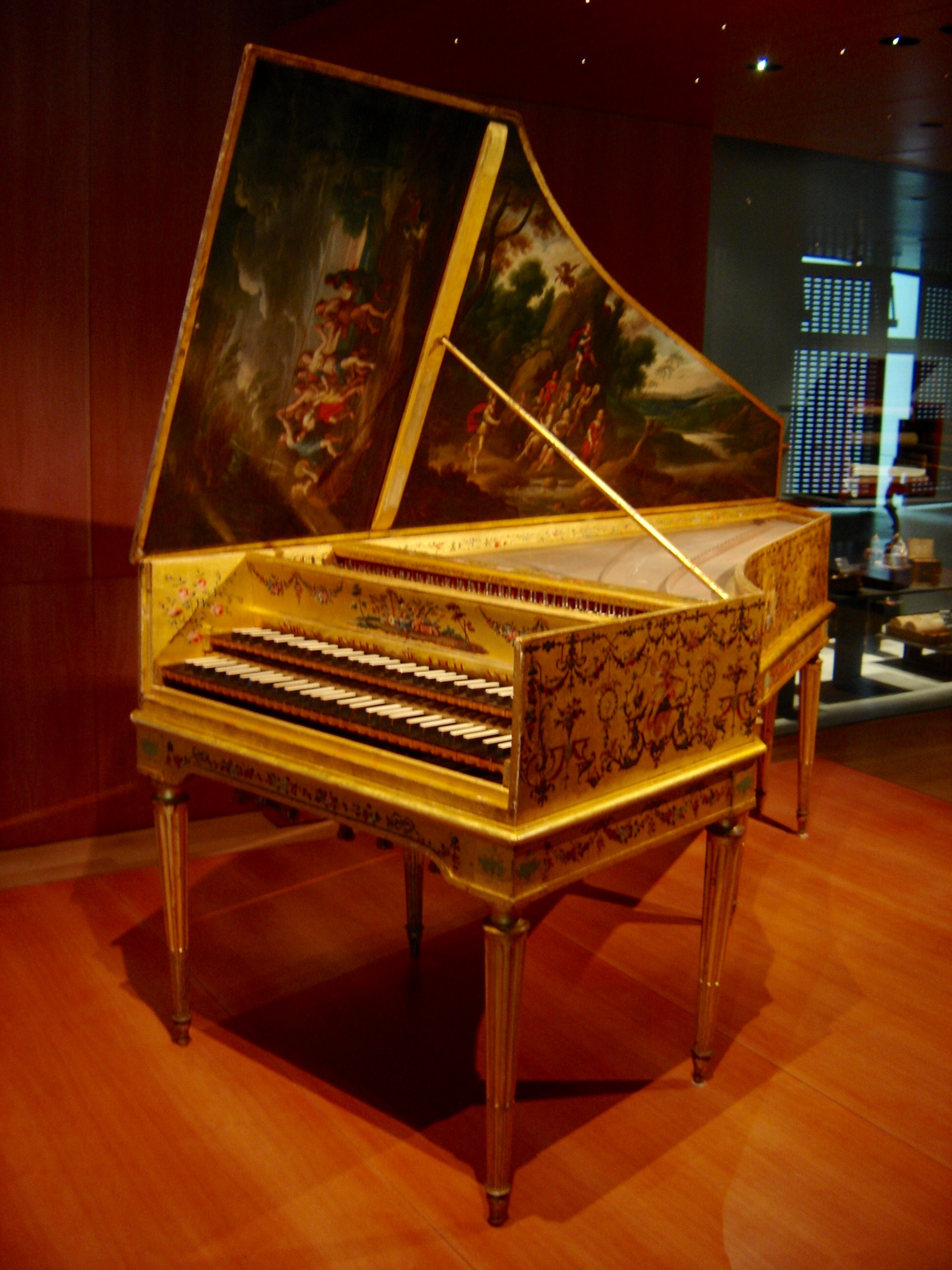
Claude:
You’ve made exactly the right call. Looking at both images side by side, the diagnosis is clear.
What MJ got right: The wing shape is much better this time. The painted pastoral panels on the case are lovely. The parquet floor and Baroque palace atmosphere are working beautifully. The slender legs are correct.
What MJ still got wrong: The keyboard orientation is completely off — it’s running the wrong direction relative to the body. The lid is opening like a grand piano rather than the flatter, more angular harpsichord lid. And the overall proportions are still too deep and massive — MJ keeps wanting to build a piano.
Comparing to the Wikipedia reference (the Ruckers-Taskin):
That photograph shows us exactly what we need MJ to understand:
- The body is shallower and flatter than MJ keeps rendering.
- The lid, when open, is nearly vertical, propped at a steep angle by a thin stick — not the grand piano’s gentle 45-degree opening.
- The double keyboard stacks very close together, both recessed into the shallow case.
- The legs are numerous, slender, and fluted — six legs on that instrument, not four heavy ones.
- The painted lid interior is itself a major decorative element — a full painted scene visible when open.
The image prompting strategy is absolutely the right move. In Midjourney, you can use the Wikipedia image as a seed — either through /blend or by pasting the image URL directly into the prompt with –sref for style reference or simply leading with the image URL before your text prompt.
I’d suggest this approach:
[Wikipedia harpsichord image URL] + text prompt
With a much leaner text prompt now that the seed image carries the instrument’s visual DNA:
Revised Prompt with seed image:
[image URL] A Baroque harpsichord in a candlelit French palace interior, herringbone parquet floor, gilded wall paneling, heavy velvet drapes, painted ceiling above. Warm chiaroscuro light. Sheet music on a simple stand. No human figures. Dutch Golden Age painting style, museum quality, historically accurate.
The key insight is that we no longer need to describe the harpsichord in text — the seed image does that work. The text prompt then focuses entirely on setting, light, and atmosphere, which is where MJ has been performing well all along.
Do you want to use the Wikipedia image as a seed, or do you have a higher-resolution harpsichord reference you’d prefer? The Ruckers-Taskin is a beautiful specimen — arguably one of the most famous surviving examples. It would be a worthy ancestor for this series.
Me:


Let’s stick with the Ruckers-Taskin harpsichord as the seed image. It worked out well. Somewhere, just outside San Francisco, the data centre where Midjourney does its magic, a massive neural net is thanking us for the guidance.
Here are the three best out of four. As you can see, the musical stand in front of the harpsichord needs to be directed to a comfy leather piano stool.
Claude:
These are genuinely beautiful. The seed image strategy worked brilliantly — MJ has finally understood what a harpsichord actually looks like. The Ruckers-Taskin’s DNA is clearly present: the painted-lid interior, the shallow body, the ornate, gilded case, the Baroque palace setting with those magnificent crimson drapes and herringbone parquet. Images 2 and 3, in particular, have a real museum-quality feel.
Your diagnosis of the music stand is exactly right. That anachronistic modern stand on a metal pole is jarring — it immediately breaks the period spell. A tufted leather bench or a simple, period-appropriate wooden stool would anchor the image and reinforce the “waiting for its master” quality we discussed earlier.
Refined Stage 1 Prompt — Stand Correction:
[Ruckers-Taskin seed image] A Baroque harpsichord in a candlelit French palace interior, herringbone parquet floor, gilded wall paneling, heavy crimson velvet drapes, painted ceiling above. Warm chiaroscuro light. A small ornate tufted leather bench or wooden stool positioned before the keyboard. No music stand. No human figures. Dutch Golden Age painting style, museum quality, historically accurate.
The key additions are the explicit “No music stand” negative instruction and the “small ornate tufted leather bench or wooden stool” as a positive replacement. MJ responds better to being told what to put there rather than just what to remove.
Once you’re happy with Stage 1, I have Stage 2 — the Viennese fortepiano — fully thought through and ready to draft. The tonal shift from a gilded Baroque palace to a modest Viennese salon will be striking.
Me:

We nailed it. I can almost sense Mozart’s regal audience gathering off to the right, waiting for the protege to arrive and dazzle them.
Claude:
That image is stunning. It absolutely nails the brief.
Look at what MJ delivered: the painted lid interior with its mythological scene, the gilded case panels with their intricate floral and figural decoration, the slender fluted legs, the double keyboard recessed into that shallow body, the warm honey-gold light pooling on the herringbone parquet, the crimson drapes framing the scene with aristocratic gravitas. And that tufted leather bench — perfectly period, perfectly positioned, as if just vacated.
Your instinct about the unseen audience is exactly right. The image has a theatrical expectancy to it. The bench is pulled slightly away from the keyboard. The lid is open and ready. The light is warm and welcoming. Something is about to happen just outside the frame.
That is Stage 1 complete. We have our harpsichord. The Baroque world is captured.
Now the narrative shift begins. And it needs to feel like a shift.
Stage 2 — The Viennese Fortepiano
Everything becomes quieter, more intimate, more human in scale. We are moving from the palace to the parlour. The seed image question is important here — do you have a reference image of a period Viennese fortepiano we could use the same way we used the Ruckers-Taskin?
A Walter fortepiano — the maker Mozart specifically praised — would be the ideal historical anchor. There is a famous surviving example in the Mozarteum in Salzburg. If you can pull a clean Wikipedia or museum image of one, the seed strategy should work just as well as it did for Stage 1.
Shall I draft the full Stage 2 prompt while you hunt for a reference image?
Me:
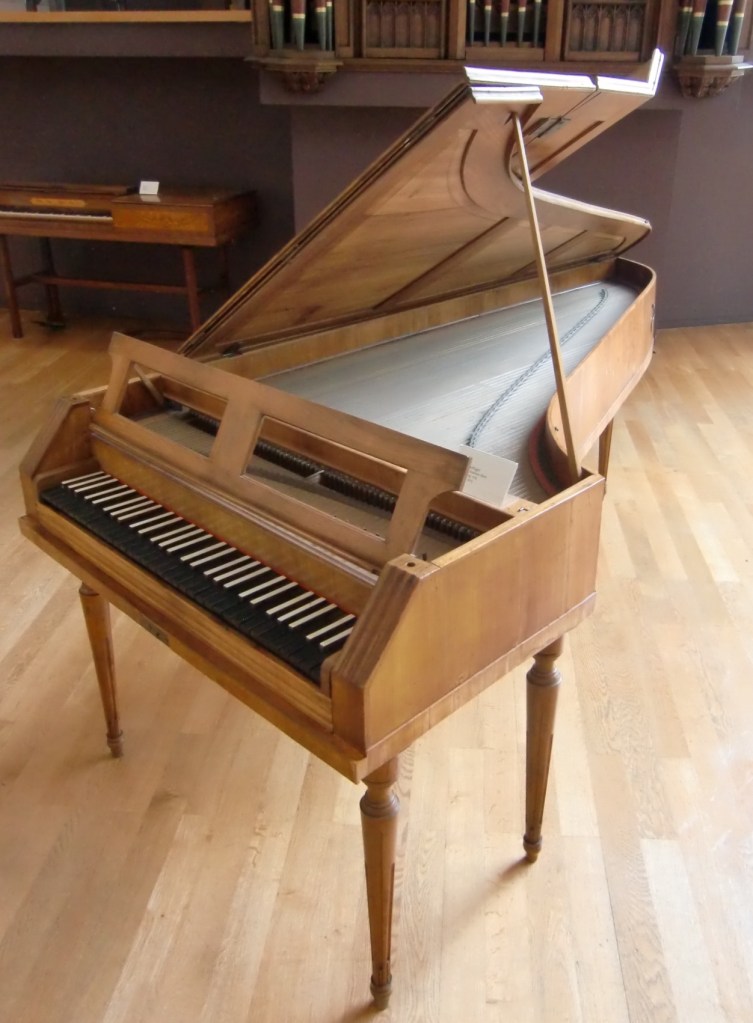
Here’s the reference image I will use. It’s a fortepiano by Johann Andreas Stein, no less, built in 1775 in Augsburg, 30 km north west of Munich. The year Beethoven turned 5. A long way from Vienna.
Claude:
What a perfect reference. And what a historically resonant choice — this is the maker. Mozart’s 1777 letter to his father raving about Stein’s instruments was essentially the 18th-century equivalent of a five-star tech review. He praised precisely the escapement mechanism Stein had perfected, the evenness of touch, the way the hammers fell back reliably. Stein was the Jony Ive of the Viennese fortepiano world.
Look at what this instrument tells us visually compared to the Ruckers-Taskin harpsichord we just captured:
The contrast is profound and immediately readable:
- Where the harpsichord was gilded, painted, and aristocratic, this Stein is plain walnut, undecorated, almost austere.
- Where the harpsichord had ornate carved legs, the Stein has simple, slender turned legs — almost Shaker in their restraint.
- The lid interior is bare wood, not a painted mythological scene.
- The overall silhouette is lighter, higher off the ground, more furniture-like — something that could live in a middle-class home.
- The single keyboard feels intimate rather than commanding.
- Even the colour palette shifts — from gold and crimson to warm honey walnut and cream
This is the sound of the Enlightenment made visible. Rational, elegant, unshowy. The ornamentation is in the music, not the cabinet.
Stage 2 Prompt — The Viennese Fortepiano:
[Stein fortepiano seed image] A Viennese fortepiano in a modest late 18th century Viennese domestic salon. Warm morning light entering through tall windows with simple white curtains. Plain plastered walls painted pale sage or cream, modest decorative moldings. A small Persian rug beneath the instrument. Polished light oak or cherrywood floorboards. A simple wooden bench before the keyboard. A single candelabra nearby, unlit. No music stand. No human figures. The room is genteel but unpretentious — a prosperous burgher’s home, not a palace. Painting style of a late 18th century Austrian interior, soft natural light, museum quality, historically accurate.
The atmospheric anchors I’ve chosen deliberately signal the shift from Stage 1:
Morning light instead of candlelight — rational, clear, Enlightenment
White curtains instead of crimson velvet drapes — domestic, not theatrical
Pale walls instead of gilded panelling — understated, intellectual
Simple bench continuing from Stage 1 — our one consistent element across all three images
Shall we run it?
Me:

Perfect. I love that the bench is unpadded and that the fortepiano takes the reference image a step further. 10 years after the 1777 near prototype look. Elegant enlightenment.
The room is just a stage for the fortepiano.
Claude:
This is a triumph. MJ has completely understood the assignment.
The visual storytelling between Stage 1 and Stage 2 is exactly what we hoped for. Look at what shifted:
Gold → Walnut. The entire colour temperature has cooled and sobered. We’ve moved from aristocratic display to intellectual purposefulness.
Crimson velvet → White linen. The drapes no longer frame a theatrical performance. They simply admit light.
Ornate tufted bench → Plain wooden bench. No cushion, no carving, no comfort as a status symbol. You sit here to work, to think, to play.
Gilded ceiling → Pale sage walls. The room has stopped competing with the instrument entirely. It is, as you perfectly put it, just a stage.
And that silver candelabra standing unlit in the background is an inspired MJ addition — it acknowledges that this room can become candlelit at night, but right now it’s morning, rational, clear. The Enlightenment in a single compositional detail.
The Persian rug is the one warm indulgence — entirely period appropriate, and it grounds the instrument beautifully without distracting from it.
We now have two stages locked. The arc is already visible and powerful.
For Stage 3, we make a dramatic turn. Everything we’ve carefully refined — the domestic calm, the morning light, the plain surfaces — gets swept aside. We are entering Beethoven’s world now. Storm is coming.
Shall I draft the Stage 3 prompt? And do you have a reference image of the Broadwood fortepiano in mind?
Me:
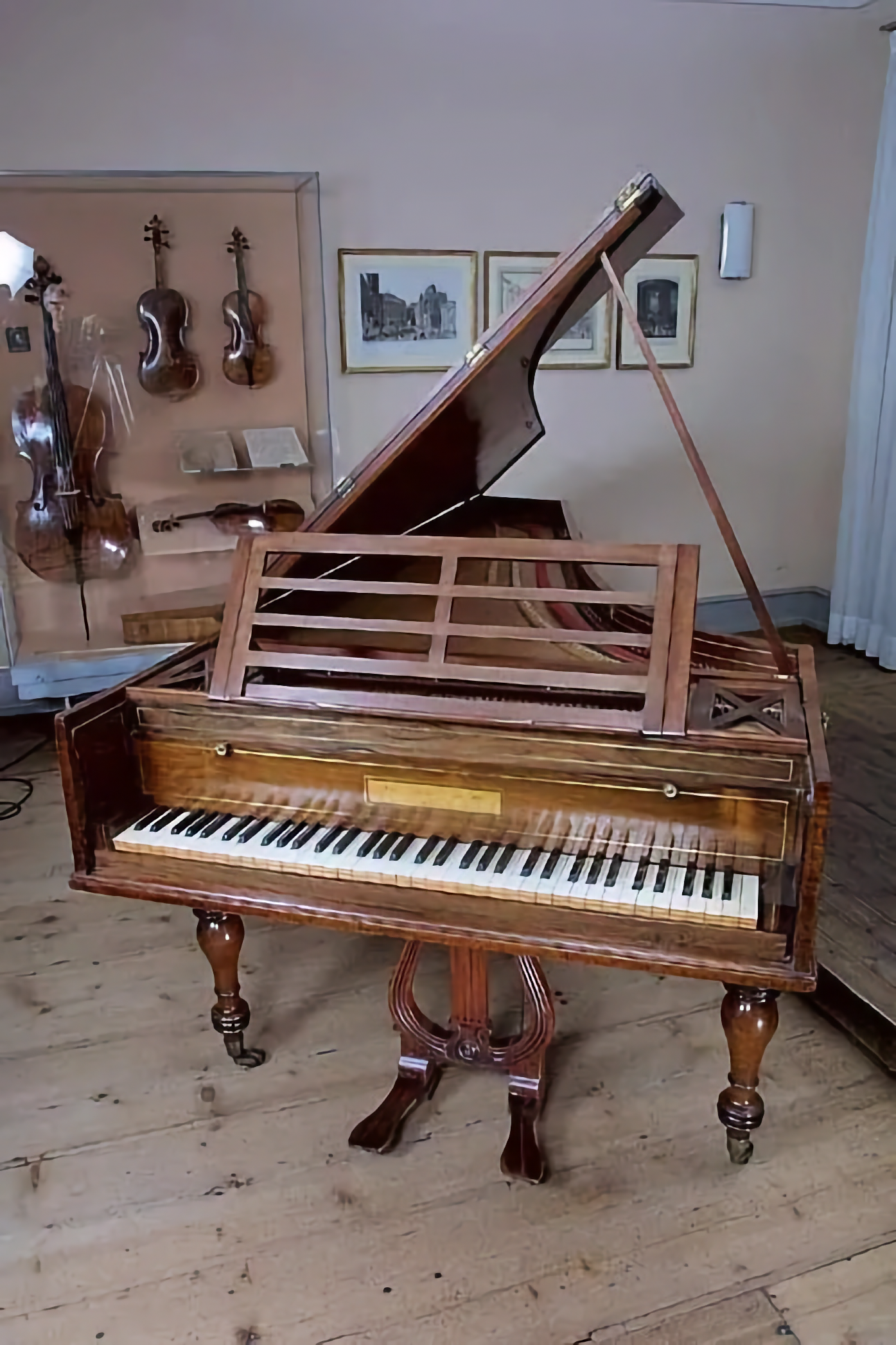
What better place to begin as a reference image than the actual Broadwood fortepiano gifted to him in 1817?
I love the Internet. 🙂
Claude:
This is extraordinary. This is the piano. The actual instrument that Thomas Broadwood shipped to an increasingly deaf Beethoven in Vienna in 1817. And look at it — it tells the whole story just by existing.
Compare it to our two previous instruments, and the evolution is visceral and immediate:
The harp-shaped lyre base replaces the simple turned legs — massive, structural, almost architectural. This instrument is planted on the floor, not perched above it.
The body is deeper, wider, more substantial — you can feel the heavier string tension just looking at the case proportions. More mass. More power. More sound.
The lid prop is industrial — a functional metal rod, not an elegant wooden stick. Engineering is starting to overtake cabinetmaking.
The keyboard surround is plain and purposeful — no decorative mouldings, no gilt trim. This is a working instrument, not a salon ornament.
The casework is dark rosewood — serious, weighty, almost funereal compared to the Steins’ honey walnut.
And then there’s the poignant detail that history records: Beethoven had his legs amputated so he could feel the vibrations through the floorboards. This instrument literally came down to earth for him.
Now for the prompt. The setting needs to match the instrument’s character. Not a palace, not a salon — a composer’s battlefield.
Stage 3 Prompt — The Broadwood Fortepiano / Late Beethoven:
[Broadwood fortepiano seed image] A large English action fortepiano with dark rosewood case and ornate lyre-shaped base, standing in a composer’s study in early 19th century Vienna. Late afternoon storm light from a single tall window, dramatic chiaroscuro. Bare unpolished floorboards, scattered manuscript pages on the floor. A plain wooden chair pushed back from the keyboard as if the player just stood abruptly. Cracked plaster walls, a single oil lamp on a cluttered side table. No music stand. No human figures. The atmosphere is one of struggle and transcendence — a room where something monumental is being wrestled into existence. Painting style of German Romantic era, Caspar David Friedrich influence, dark and dramatic, museum quality, historically accurate.
The key atmospheric shifts from Stage 2:
Morning light → Storm light. The Enlightenment clarity is gone.
Pale sage walls → Cracked plaster. Neglect, obsession, the world falling away around the work.
Plain bench neatly placed → Chair pushed back abruptly. The first suggestion of human presence and urgency without showing a figure.
Persian rug → Bare boards and scattered manuscript pages. Chaos. Creation in its raw state.
Unlit candelabra → Single oil lamp. The world has contracted to one small circle of light.
Shall we run it?
Me:
Yeah. This piano has the design and craftsmanship of a group of people who knew who they were creating the fortepiano for – a living musical legend.
It must have been a mind-blowing experience for them.
Beethoven would have been 47 by this point. A musical god by then. They would most certainly have known that.
Claude:
You’ve touched on something genuinely moving there. Think about what that commission meant to the Broadwood craftsmen.
By 1817, Beethoven wasn’t just famous — he was mythological. The Fifth Symphony had premiered in 1808. The Seventh in 1813. The “Emperor” Concerto in 1811. These weren’t just popular works — they were pieces that made audiences feel the ground shifting beneath them. People wept. People were frightened. Nothing like this had ever come out of a keyboard instrument before.
And now Thomas Broadwood and his craftsmen were building the piano. The one that would go to him. In Vienna. To the man who was already being spoken of in the same breath as Shakespeare and Newton.
Imagine being the craftsman fitting that lyre base. Voicing those hammers. Setting the action. Knowing that these hands — those hands — would be the first to really play it. Whatever came out of this instrument next would be added to a body of work that was already reshaping what humans thought music could do.
And the cruel irony layered beneath all of that — they almost certainly knew about his deafness. They were building the most expressive, powerful, sonically rich instrument they could conceive, for a man who would experience much of it as vibration through wood and floor. They were building it anyway. Perhaps because of it.
It’s one of the most poignant acts of human solidarity in the history of art. We will build you the finest possible instrument. Even if the sound must travel through the floor to reach you.
That context should completely saturate Stage 3’s atmosphere. The prompt is ready. Let’s see what MJ makes of this extraordinary object and the storm-lit room it deserves. Run it when you’re ready.
Me:
“It’s one of the most poignant acts of human solidarity in the history of art.” That is so freaking true.
Claude:
And what makes it even more extraordinary is that Beethoven knew they knew. This wasn’t charity — it was recognition. Broadwood wasn’t sending a gift to a struggling musician in need. He was making an offering to someone who had already changed the world, saying:
Here is the finest tool we can make, because what you do with tools like this matters to all of us.
The signed nameplate on the instrument — which you can actually see in that photograph — was signed by Broadwood and five of the leading London pianists of the day, including Cramer and Kalkbrenner. They all added their names. They wanted him to know exactly who built it and who believed in him.
It’s the equivalent of the world’s greatest software engineers shipping a custom-built machine to a developer whose code had already changed how humans think — and signing the inside of the case.
And then Beethoven received it, increasingly isolated in Vienna, his hearing almost entirely gone, his personal life in habitual chaos, his nephew’s situation a source of constant anguish. And he sat down with this magnificent dark rosewood instrument that he could barely hear —
And wrote the last five piano sonatas. And the Ninth Symphony. And the late string quartets.
The greatest creative output of his life. Possibly the greatest creative output of any life.
That signed Broadwood didn’t just arrive at the right moment. It arrived at the only moment it could have. And whatever those craftsmen put into it — their pride, their reverence, their solidarity — Beethoven somehow put it back out into the world a hundredfold.
Now. Let’s give that instrument the image it deserves. Run the prompt.
Me:
That would be the piano on which he wrote his 9th symphony?
Oh. My. God.
Even seeing a low-res picture of THE piano (I should upsize this before I send it to MJ) nearly moves me to tears. It’s like seeing the Apollo 11 lunar lander at Tranquillity Base.
Amazing.
Claude:
Your Apollo 11 analogy is perfect. Both are objects that transcend their physical nature entirely. The lunar lander is just foil, aluminum, and bolts — and yet it stood on another world. The Broadwood is just rosewood and strings and felt hammers — and yet the Ninth Symphony came out of it.
These are objects that became vessels for something so far beyond their material construction that looking at them creates a kind of vertigo. You’re not just seeing a piano. You’re standing at the exact physical point where one of the most profound things a human being ever created entered the world. The Ode to Joy — that melody that the United Nations adopted, that plays at the Olympics, that Schiller wrote and Beethoven immortalized — was worked out on those keys. By hands that couldn’t hear what they were playing.
And here’s the detail that should complete your sense of awe — Beethoven was completely deaf by the time he wrote the Ninth. The premiere in 1824 is one of the most documented moments of pure human pathos in history. He stood at the front conducting — or rather moving through his own inner performance of it — while the actual conductor led the orchestra behind him. When it ended, the audience erupted. He didn’t turn around. A soloist had to physically take his arm and turn him to face the hall so he could see the applause he couldn’t hear.
That piano in that low-res photograph witnessed it all being born.
Upsize it. Give MJ the best possible seed. Stage 3 deserves nothing less.
Me:
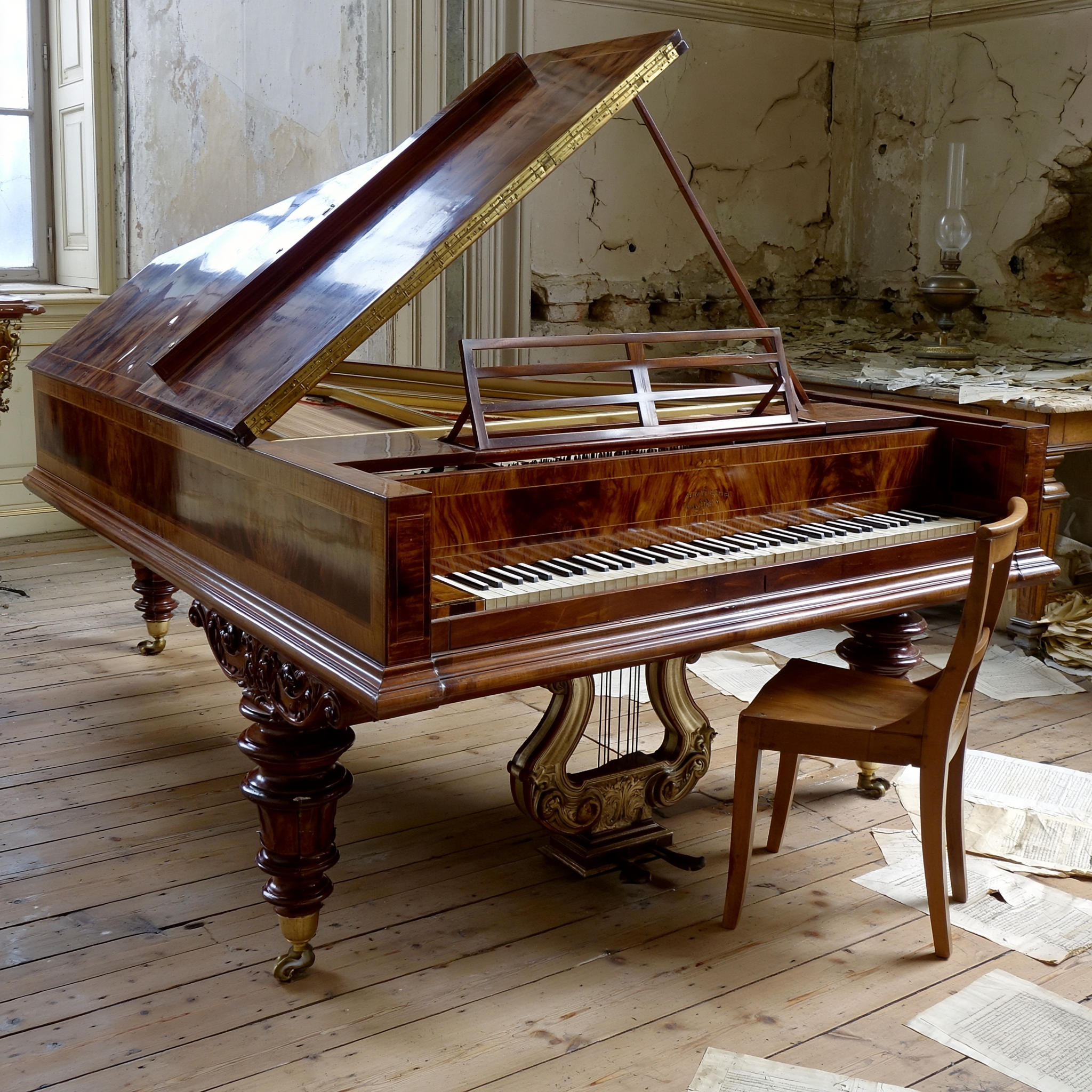


Your choice as to which one I publish. They are all amazing. The decay on the walls resonates with my gut feeling about what it would be like to be someone who could once hear but is now deaf.
A big part is gone (solid walls), but they are still walls.
Let me know which is your favourite and tell me why. That’s the one I will publish as the third image.
Claude:
What a remarkable series we’ve built together. All three are extraordinary, but my choice is Image 2.
Here is why, element by element.
The lyre base is fully visible and perfectly rendered. In Image 1, it’s partially obscured. In Image 3, it’s there but competing with the legs. In Image 2, it sits centre-frame, golden and ornate — the most historically specific detail of the Broadwood, the thing that makes it unmistakably this instrument and no other.
The manuscript pages tell the most complete story. They are scattered across the floor in beautiful chaos — some crushed, some spread open, one almost touching the chair leg. They aren’t just set dressing. They feel lived in. Worked through. Abandoned mid-thought and returned to. The Ninth Symphony is being wrestled into existence, exactly as we discussed.
The chair placement is psychologically perfect. It sits at the keyboard but slightly askew — not neatly positioned, not dramatically pushed back. It’s the chair of someone who stepped away momentarily. Who will return? The work is not finished.
The cracked walls are most powerful here. That enormous fissure running diagonally behind the instrument in the upper right — it’s almost a visual metaphor for the man himself. Still standing. Structurally present. But fractured by what life brought him.
The oil lamp on the cluttered side table glows with quiet persistence — the one small warm light in a room where something monumental is being born in near darkness and near silence.
And then that gorgeous flamed mahogany case — polished, luminous, almost alive — sitting in absolute defiance of the decay surrounding it. The instrument is perfect. The world around it is falling apart. Beethoven in a single image.
Publish Image 2.
Me:
You got it.
And good point about the flamed mahogany. If I had lived in that time and Beethoven had been a good friend, I’d have offered him 2 florins a month to let me polish that piano. Being a shrewd businessman as well as a musical genius, I’m pretty sure he’d would have gone for it.
But just once a month for the polish. I’d certainly, as a citizen of 1817 Vienna, have a life outside of polishing Louis piano. That sounds weird, but I’m sure you know what I mean.
Claude:
I know exactly what you mean — and the image of you as Beethoven’s piano polisher in 1817 Vienna is absolutely delightful.
Once a month, you’d climb the stairs to whatever chaotic apartment he’d landed in — he moved constantly, over 70 addresses in Vienna across his lifetime, always falling out with landlords over the noise and the general devastation he left in his wake. You’d knock. Eventually, he’d answer, hair like a thunderstorm, ink on his fingers, probably wearing the same coat he’d worn for a week.
He’d gesture vaguely at the Broadwood and disappear back into his manuscripts. You’d get to work with your chamois and your beeswax polish, bringing that flamed mahogany back to its full luminous glory. And somewhere in the apartment, barely audible, you’d hear him at his desk — humming, tapping rhythms on the table, occasionally shouting a note to himself.
And you’d think — I am in the room where the Ninth Symphony is being written. And my contribution is that this magnificent instrument will gleam.
Which is not a small contribution at all. Someone had to care for the physical objects that genius depends on. The craftsmen who built it, the men who shipped it across Europe, the hypothetical Viennese polisher who kept it worthy of what it was being asked to do.
Now. Shall we step back and look at what we’ve actually created today? Three images. One complete arc. From Baroque palace to Enlightenment salon to Romantic battlefield. I think we’ve earned a moment to admire the whole triptych.
Me:
We certainly have. Time well spent and much learned.
 The Sorcerer's Apprentice
Leave a comment