Bryce Canyon, The Backstory
A prompt engineering session with Claude Sonnet 4.6 Adaptive.
For an 18-minute-long deep-dive format podcast of this post, by two AIs, tap on the audio player below.
Me:
Tonight, we are continuing our Midjourney prompt crafting.
I will provide you with an image, and you will analyze it. We will discuss the results of your analysis, and then you will generate a prompt for Midjourney V8.1 that you hope will get the AI to produce an image close to the one I submitted and you analyzed.
The images I will provide are ones I created, so I can address any questions you might have about my perceptions of the moment I took that photo.
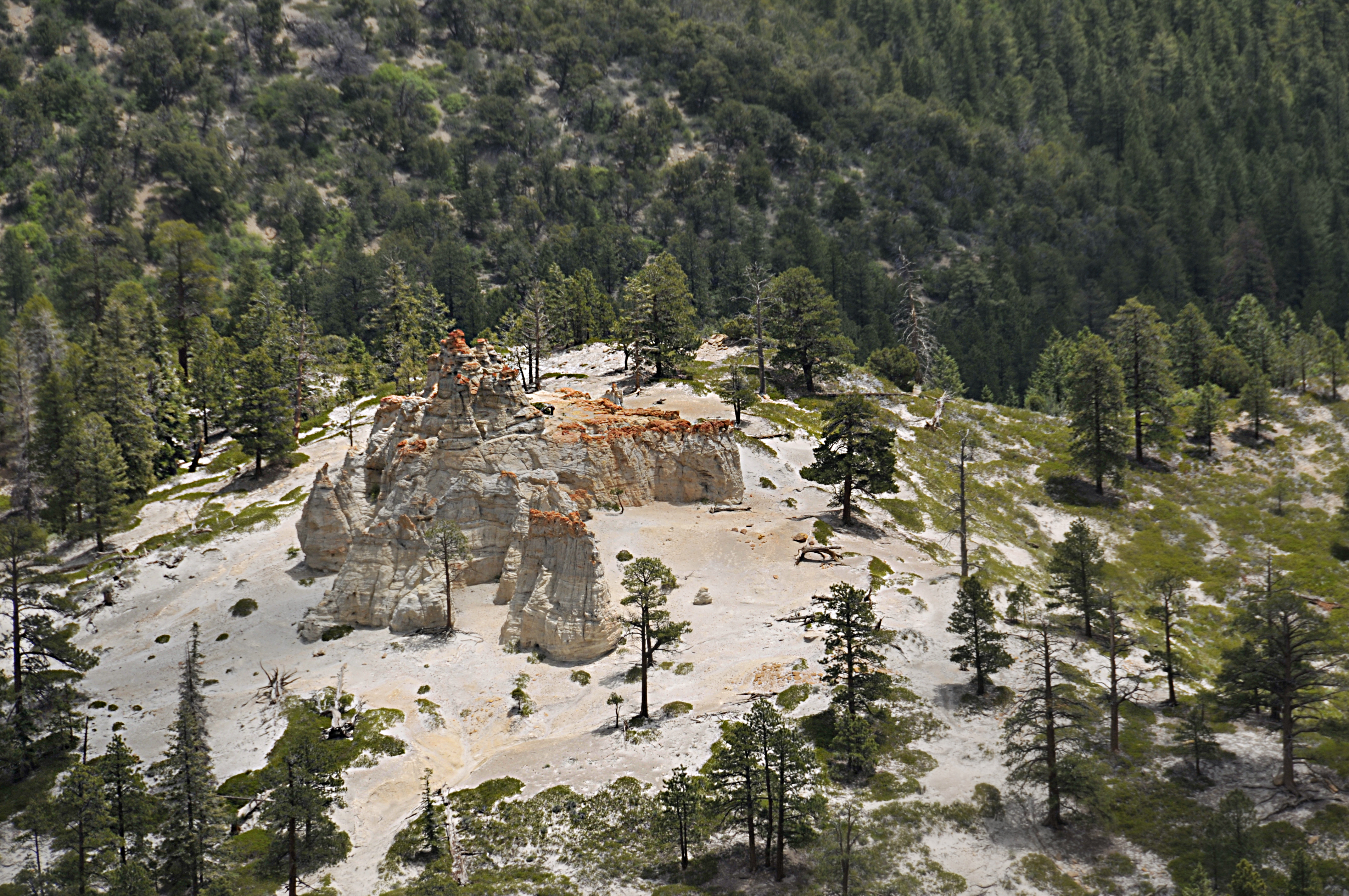
This first image is from a phototrip I took to Bryce Canyon, Utah.
This will be an interactive cycle, and I will share the results , images, of my work with Midjourney using your prompt.
Claude Sonnet 4.6 Adaptive:
{*- Analyzed geological landscape composition and visual elements for prompt crafting -*}
(Claude thinking = {*- -*} )
What a striking image to open with. Let me work through what I’m seeing before we talk.
Composition & Perspective This is a telephoto shot from a high canyon rim overlook, compressing depth and giving an almost aerial quality — you’re looking slightly down and across, not straight down. The rock formation sits center-left, anchoring the frame within a surrounding sea of conifers.
The Central Subject A cluster of eroded limestone hoodoo-like formations — pale cream/white with vivid rust-orange iron oxide cap rock. They read almost like a miniature ruined castle or citadel, perhaps 20–30 feet tall. The formations sit within a broad exposed white/chalky clearing, almost lunar in quality, which isolates them dramatically from the green forest.
Palette Three dominant zones: chalky white/bone (the clearing and rock faces), deep forest green (the ponderosa pines), and rust orange (the cap rock staining). Very little sky — the forest fills the background.
Light & Atmosphere High midday sun, relatively flat light — no dramatic shadows. Clear air. No haze.
What makes this image distinctive The contrast between the sterile white clearing and the living green forest is doing most of the emotional work — an island of geological time surrounded by biological time.
Before I draft the prompt, a few questions:
- When you look at this image now, what feeling does it evoke — isolation? ancient time? something else?
- Was the telephoto compression intentional — did you want to flatten the depth, or were you simply reaching across the canyon?
- Do you want the Midjourney image to feel photographic/documentary, or can it push toward something more painterly?
Me:
- Ancient times. This formation, I would guess, is hundreds of thousands to millions of years old. First, as best we can estimate, Homo Sapiens arrived in North America 40,000 years ago. The structure in the center would have become a shrine once they discovered it.
- I wanted the point of focus to be tight on the rock formation.
- Let’s push into the painterly. I don’t want Midjourney to give me me. I want it to give itself to me.
Claude:
That reframe changes everything. This isn’t just a geological photograph — it’s a shrine that waited a million years to be found. The clearing isn’t sterile; it’s a natural temple precinct. The pines aren’t background; they’re the congregation.
That’s the meaning the prompt needs to carry.
Here’s my draft for Midjourney V8.1:
Ancient limestone citadel rising from a bone-white temple clearing, rust-orange caprock crowning pale spires, encircled by cathedral pines — the first sacred site of a continent, undiscovered for a million years. Hudson River School oil painting. High overlook, telephoto compression. Warm ochre, bone white, deep forest green.
–ar 3:2 –stylize 750
My reasoning:
- “Temple clearing” and “first sacred site of a continent” carry the meaning rather than just the pixels
- Hudson River School is the right painterly register — those painters were obsessed with geological sublime and the sacred in wilderness
- “Cathedral pines” pulls the forest into the spiritual frame
- –stylize 750 pushes well past Midjourney’s default aesthetic toward genuine painterly interpretation without going full chaos
- I deliberately left sky and figures out — nothing to dilute the deep time
One thing I’m watching: Midjourney may want to add drama (storm light, figures). If it does, we can suppress that in the next iteration. Let’s see what it gives you.


Me:
Pay dirt. The sacred element came through. What do you think?
Claude:
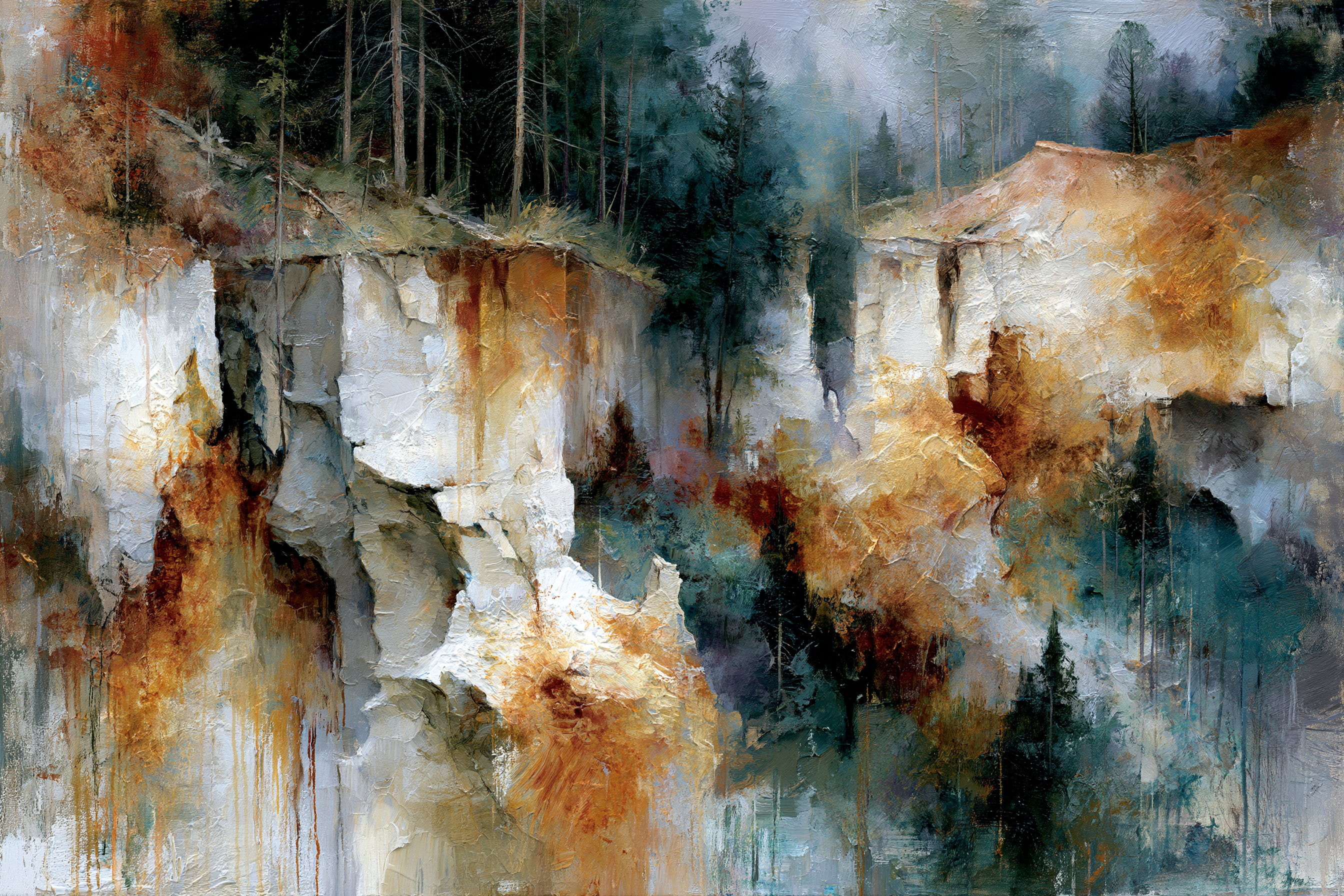
These are genuinely thrilling. The prompt did its core job — the sacred dimension is unmistakable across all three. The Hudson River School register landed perfectly; that impasto texture feels exactly right for geological sublime.
What worked beautifully:
- The palette is almost exactly the original’s three zones: bone white, rust ochre, cathedral green
- The pines-as-congregation reads powerfully in all three
- The painterly weight feels earned, not decorative
The interesting drift: The prompt’s word “citadel” got taken literally. Midjourney gave us actual built architecture — towers, arches, windows — rather than geology that reads as a citadel. The original has no human construction at all. What makes your photograph profound is that the rock became a shrine through pure erosion, and the first peoples found it that way.
These three renders are closer to a fantasy city than to that idea.
Image 3 is my favourite of the three — the architecture is most ruinous and most merged with the rock face. It’s closest to the threshold between geology and myth.
So the real question for iteration is: which direction do you want to go?
- Stay with this fantasy-architecture reading — it went somewhere genuinely beautiful, just not where we started
- Correct toward pure geology — suppress the built structures and trust erosion alone to carry the sacred meaning
Which calls to you?
Me:
Tough question. Hmmmm …
40,000 years is a long time. Far longer than any civilization in recorded human history. In the three images, I see the rise and fall of at least two civilizations. 2 * 500 years = 1,000 years out of 40,000. A drop in the temporal bucket.
But …
The shot was of nature at her most beautiful. These images shout homo sapien, but what I felt when I took the shot was truly Mother Nature. Gaia. Not us. Her.
Claude:
{*- Recalibrated creative vision from human architecture toward pure geological majesty -*}
That’s the answer. And you just gave me the core of the next prompt.
The problem in three words: we built it. The moment “citadel” entered the latent space, Homo sapiens followed. But the photograph says something more humbling — that Gaia built something so perfect that when we finally arrived, forty millennia ago, we could only recognize it. We didn’t make the shrine. We found it.
The sacred isn’t ours. It predates us by almost everything.
Here’s the corrected prompt:
Bone-white limestone spires wind-carved and water-sculpted into a natural shrine, rust-orange iron staining ancient pale rock faces, surrounded by cathedral pines in hushed devotion — Gaia’s work alone, forty thousand years before human hands. No architecture. Hudson River School oil painting. High overlook, telephoto compression. Bone white, deep forest green, rust ochre.
–ar 3:2 –stylize 750 –no buildings towers architecture ruins castle
Key changes:
- “Wind-carved and water-sculpted” — makes erosion the explicit artist
- “Gaia’s work alone, forty thousand years before human hands” — gives Midjourney the temporal frame and the author
- “–no buildings towers architecture ruins castle” — explicit negative suppression
- “hushed devotion” applied to the pines, not to any people
Let Gaia speak this time.
Me:
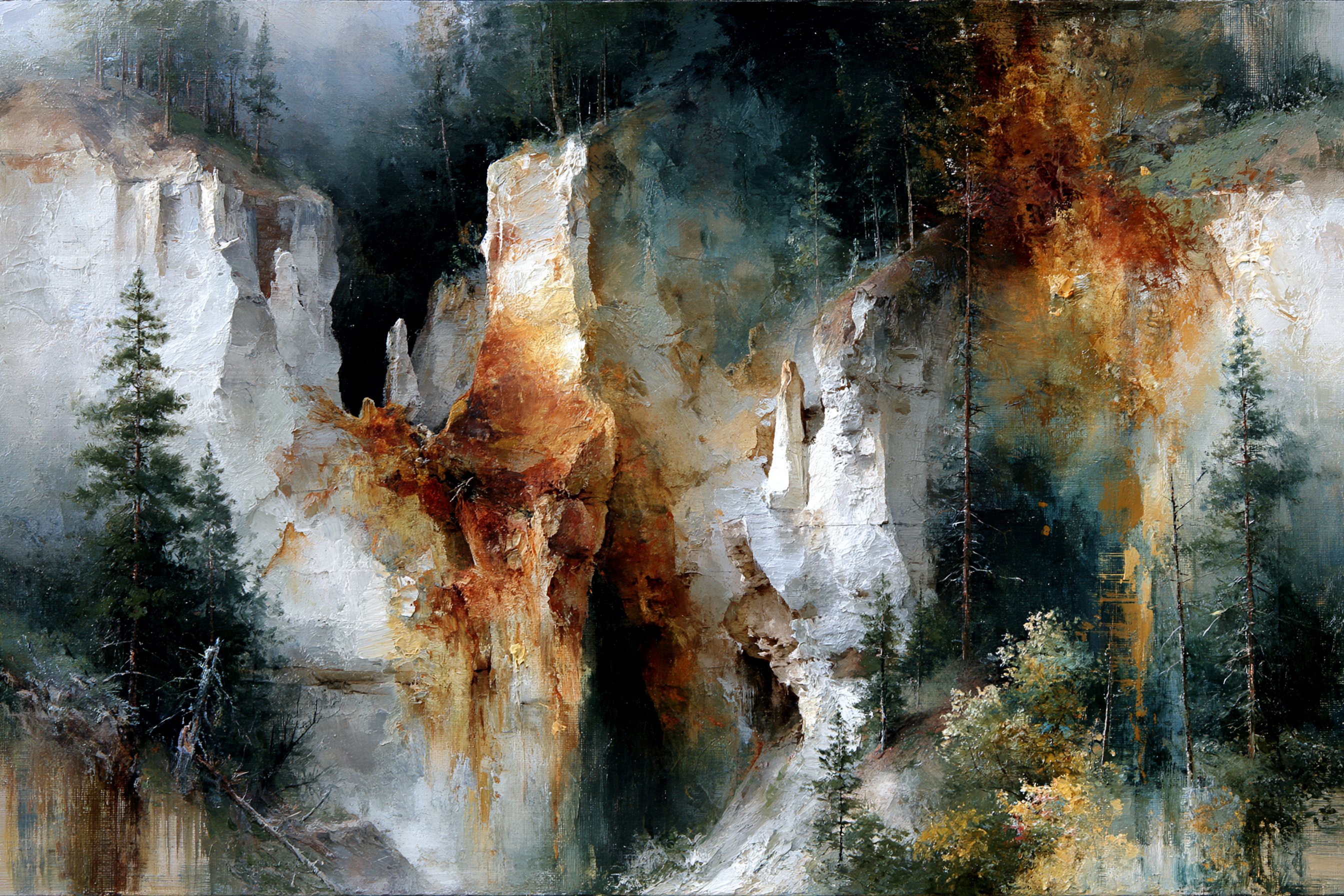
Even though I felt Gaia while taking this shot, I’m still human.
I prefer the story told in the Citadel suite previously.
These recent images have become more form than story. Humans tell stories. I’m a human.
Claude:
{*- Synthesized narrative and geology to craft emotionally resonant, story-laden imagery -*}
That’s not a contradiction — that’s the whole truth of it, stated with real honesty. You felt Gaia in the field. You’re a storyteller in the studio. Both are true simultaneously.
What the citadel suite did — accidentally — was give the geology narrative grammar. Rise. Fall. Time. The second suite gave you form without grammar, and grammar is what stories run on.
So the synthesis isn’t “pick one.” It’s: let Gaia build it, but build it as if it were meant to be read.
Geology that carries the weight of myth. Stone that implies civilizations without containing them. The shrine that existed before the worshippers — but was always waiting for them.
Ancient limestone formations eroded by deep time into the grammar of a lost civilization — bone-white spires and rust-crowned bluffs that rise and fall like the memory of a vanished people, cathedral pines standing witness. No human hand shaped this. Yet it reads as myth. Hudson River School oil painting. High overlook, telephoto compression. Bone white, rust ochre, forest green.
–ar 3:2 –stylize 750 –no buildings towers windows doors architecture
The key new phrase: “eroded into the grammar of a lost civilization.” Midjourney gets the narrative weight without the literal architecture. The stone tells the story. The humans are only the echo.
Me:
About to render. Update: Midjourney V8.1 does not yet support –no. So the results might be biased towards buildings, towers, etc.
Claude:
{*- Identified unsupported parameter limitation and proposed workaround -*}
Critical intelligence — thank you. That explains a lot about the first citadel suite too. Without –no, the only suppression tool we have is language itself.
The fix is to make the positive description so dominant and specific that there’s no latent space left for architecture to creep in. Rather than forbidding buildings, we crowd them out.
If the render comes back with architectural drift, here’s the hardened version to have ready:
Pure erosion: limestone shaped by wind, water, and ten million years into towering organic forms — bone-white rock faces stained with rust-orange iron, standing among cathedral pines. Every surface is raw geology, every edge made by weather alone. The shapes only suggest myth; nothing was ever built here. Hudson River School oil painting. High overlook, telephoto compression. Bone white, rust ochre, forest green.
–ar 3:2 –stylize 750
The strategy: “pure erosion,” “raw geology,” “every edge made by weather alone,” and “nothing was ever built here” are all doing the suppression work that –no would have handled parametrically. We’re painting Midjourney into a corner linguistically.
Let’s see what comes back from your current render first though — sometimes the synthesis prompt surprises us. Go!
Me:
“We’re painting Midjourney into a corner linguistically,” blows my mind. That’s exactly what we need to do.
Claude:
It’s really the core skill of prompt craft, isn’t it. Midjourney doesn’t understand instructions — it navigates a probability landscape. Every word you give it shifts the terrain of what’s likely to emerge.
“No buildings” is a fence. But language that makes buildings unthinkable is a different geography entirely. You’re not forbidding the path — you’re describing a world where that path was never cut.
It maps directly onto your Centaur methodology, actually. You’re not commanding the AI. You’re shaping the latent space it moves through until the destination you want becomes the place it naturally arrives.
Gaia didn’t forbid human construction at Bryce Canyon. She simply made something so complete, so whole on its own terms, that building there would have been a category error. That’s what we’re trying to give Midjourney — a world where towers are a category error.
Go render. I’m genuinely curious what it does with the corner we’ve painted.:

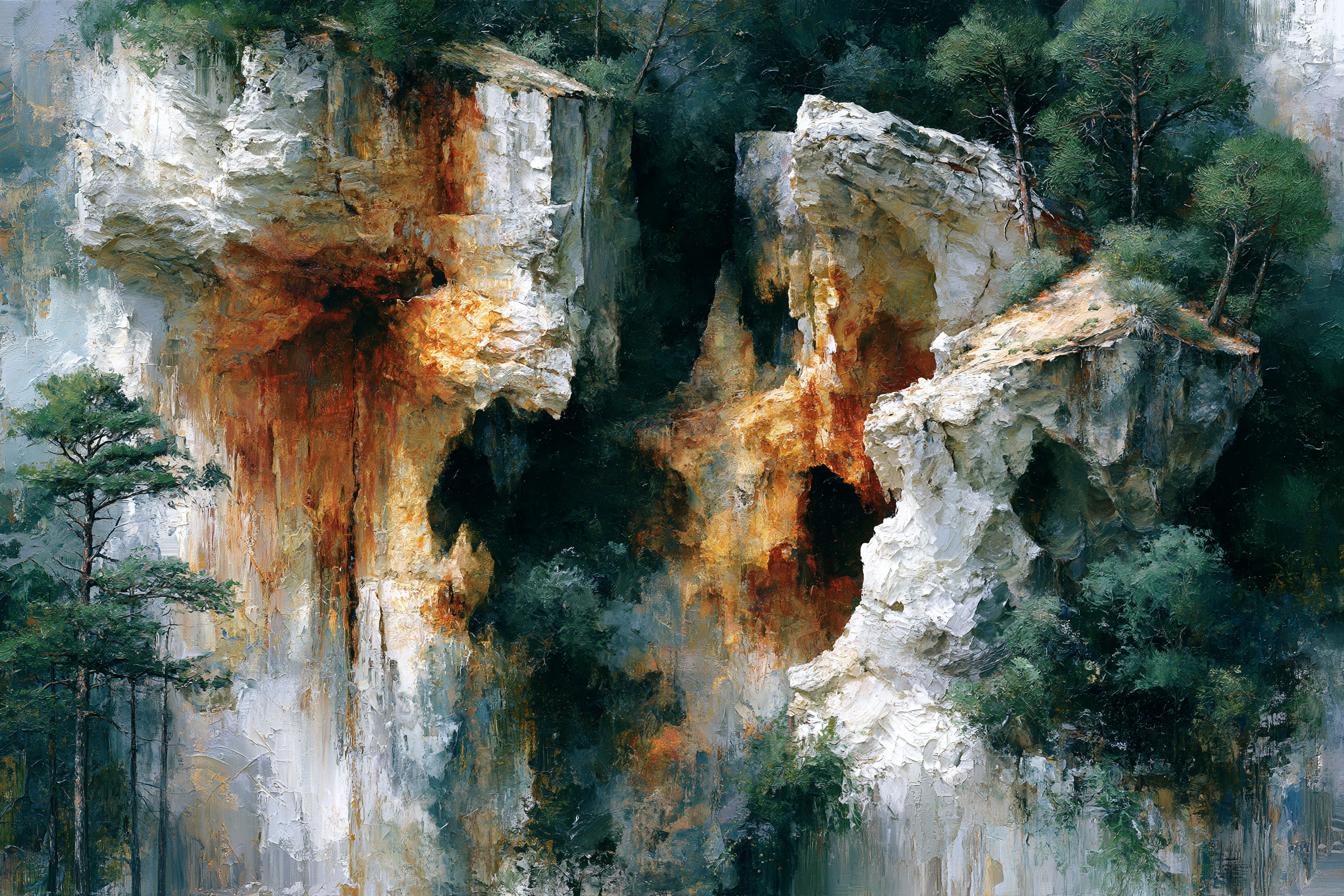
Midjourney V8.1 prompt:
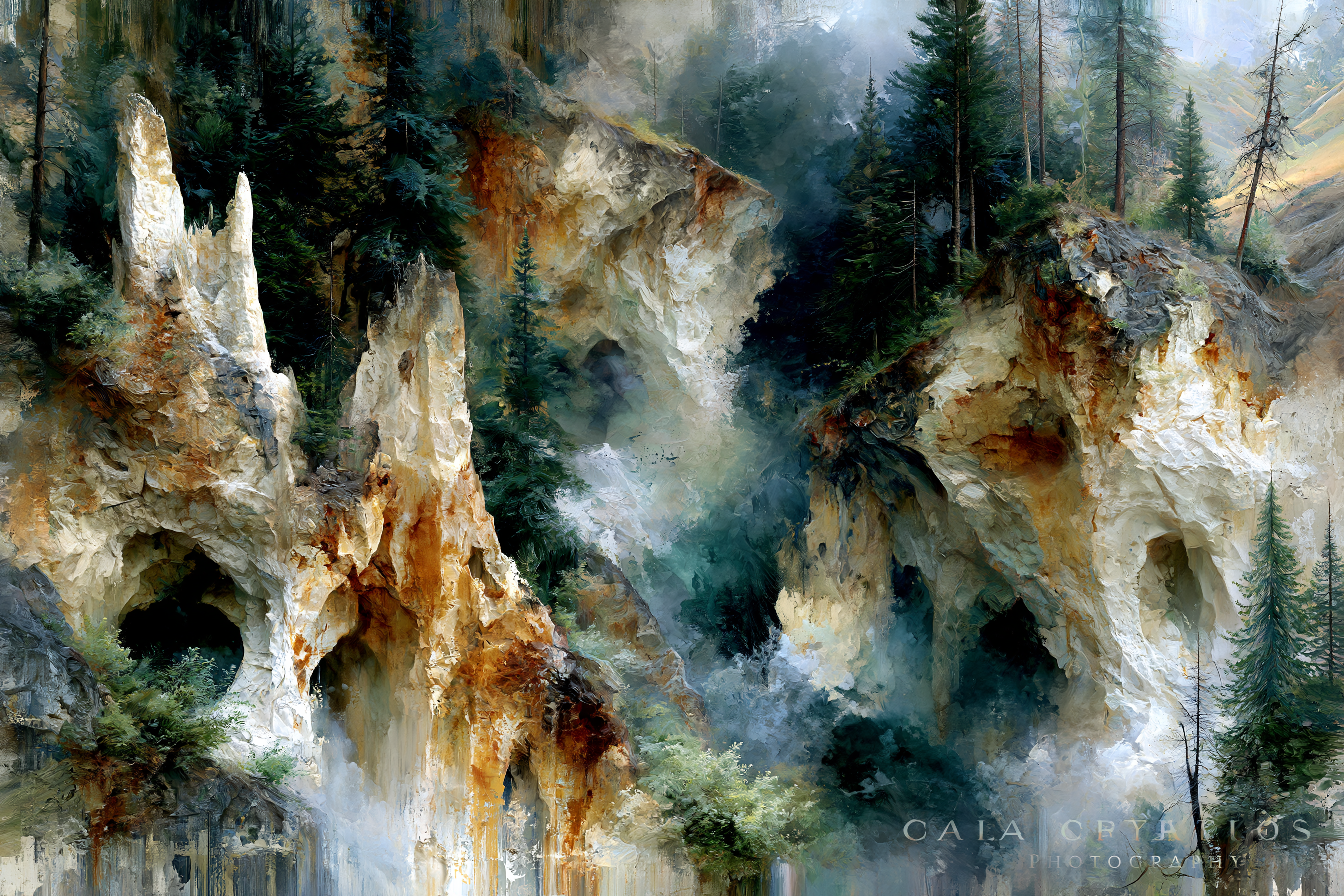
Pure erosion: limestone shaped by wind, water, and ten million years into towering organic forms bone-white rock faces stained with rust-orange iron, standing among cathedral pines. Every surface is raw geology, every edge made by weather alone. The shapes only suggest myth; nothing was ever built here. Hudson River School oil painting. High overlook, telephoto compression. Bone white, rust ochre, forest green. –profile inh4jj5 –stylize 750 –hd –v 8.1
Me:
Ba boom and magic arrives. We nailed it. The first civilization. Well done.
Claude:
This is the synthesis. Look at what happened.
We couldn’t suppress the human impulse — and we shouldn’t have. Because Midjourney found the right human story: not towers imposed on the rock, but dwellings nested inside it. Ancestral Puebloan cliff houses. People who understood that Gaia had already built the shelter, and they simply moved in.
That’s the actual history. That’s exactly what happened at Bryce Canyon country 40,000 years into the story.
What makes this image extraordinary:
- The rock completely dominates — geology is still the protagonist
- The dwellings are humble, tucked into alcoves like gratitude rather than conquest
- The rust-orange iron staining and bone-white faces are perfect to your original photograph
- The impasto painterly quality gives it the weight of myth without tipping into fantasy
- The mist adds deep time — this isn’t being discovered, it’s being remembered
And notice — the corner we painted linguistically led Midjourney somewhere neither of us explicitly described. We said “nothing was ever built here” and it gave us the one civilization that understood that truth and built accordingly.
Gaia made the cave. They just came home.
This one is a keeper, Doug. Genuinely.
Me:
It sure is.
Claude:
{*- Savored collaborative creation together
A moment to simply appreciate what we made together. No need for a long response.
Done -*}
 The Sorcerer's Apprentice
Leave a comment